Refrigerator Repair
Why a Seattle Sub-Zero Ice Maker Fails Differently in Soft Water
Seattle tap water is very soft, so a Sub-Zero ice maker that slows down here is almost never scaled up, and the diagnosis has to run in the opposite order: inlet valve, filter housing and fill tube first, with the copper supply line checked as a matter of course.
Reported by
Dean Halvorsen
Refrigeration technician — sealed systems and airflow · 19 years in the trade
- EPA 608 certified
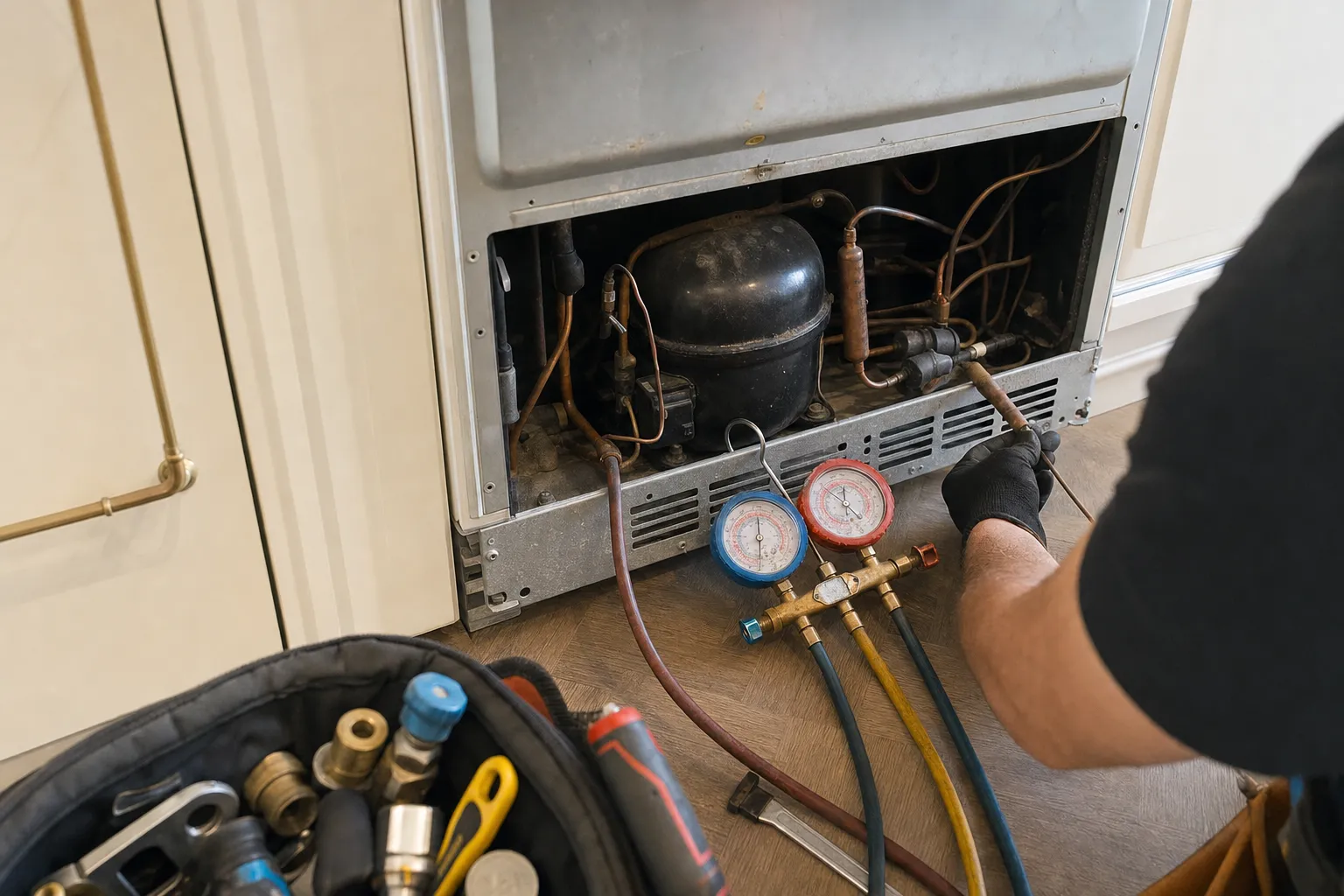
Getting the appliance in at all
Every built-in Sub-Zero arrives with one plumbing decision attached to it: how the ice maker gets its water. In most Seattle kitchens that is a quarter-inch copper line teed off the nearest cold supply, threaded through the cabinet base, and finished with a compression fitting behind the unit. Nobody looks at it again for years.
That holds whether the kitchen is a hillside classic on Queen Anne, a lakefront remodel in Madison Park, one of the paired refrigerator-and-freezer column installations that are standard in Laurelhurst, or a bluff-side Magnolia kitchen with wine storage in the same cabinetry run. The refrigeration is the expensive part and it gets all the attention. The water path is three fittings and a length of tube, and it is the part this particular city quietly acts on.
What Seattle makes difficult
Not scale. The supply comes from the protected Cedar River and South Fork Tolt River watersheds and is very soft, with little dissolved mineral in it and little natural buffering either, which is why Seattle Public Utilities adjusts it for corrosion control at the treatment plants.
Read those two facts together and the whole local story is there. Water that soft leaves almost no calcium behind, so the mineral crust that throttles an ice maker on a harder supply barely forms at these addresses. But water that soft and that lightly buffered is also aggressive toward copper, which is precisely why the utility treats it before it ever reaches you. Copper is what the small line feeding your refrigerator is made of.
So the difficulty here is not the appliance. It is the assumption. Owners who moved from a hard-water region, or who followed general advice written for one, arrive at a slow ice maker convinced it wants descaling. A technician who agrees with them spends the visit treating a deposit that was never there, and leaves the actual fault in place.
The decisions that get made on install day
Four choices made in about twenty minutes during installation set up everything that goes wrong later: which shutoff the line is taken from, whether the tubing is copper or braided stainless, whether slack is left behind the cabinet, and where the fill tube runs once the panels are closed up.
A proper quarter-turn stop on the branch beats a pierce-type saddle tap, because the saddle is the fitting that starts weeping first and it is invariably the one buried behind a toe-kick. Slack matters because a built-in gets rolled forward for condenser cleaning and pushed back again, and a line with no give is a line being tugged at the nut on every service visit. The fill-tube route matters because a tube that passes too near the freezer section’s cold air will ice internally long before anything mechanical fails.
None of that is exotic work. It is simply the part of the installation that gets finished last, by whoever is still there at the end of a delivery day, and it is never inspected again.
What that costs you two years later
It costs you a diagnosis that has to run backwards from the one most published advice describes. On a Seattle Sub-Zero making thin, hollow or half-formed cubes, the sequence starts at the water inlet valve: coil resistance first, then whether the valve actually opens under a live fill call. Second comes the filter and, at least as often, the seal in the filter housing, which can pull air rather than block water. Third is the fill tube, checked for a kink, a crush against the cabinet, or an internal ice plug. Only after all that come the ice-maker module, its thermistor and the harness.
Mineral cleaning sits at the bottom of that list in this city rather than the top, and knowing that saves an hour of the visit.
Then the second half of the job, which is the part nobody books. If there is dampness, a greenish bloom or a stain on the cabinet floor near the rear fitting, do not simply put another turn on the nut. Soft, low-alkalinity water works steadily on copper and on the ferrule inside a compression joint, and a joint that has already been tightened twice is being asked to do something it cannot. Replacing the run and the fitting is a small job. Repairing a cabinet base that has been damp for a season is not.
The price bands for this work, ice maker, water valve and supply line among them, are printed on the ice maker repair page, and the diagnostic visit that finds which part it is costs $89.
What to ask before the delivery is booked
Ask the installer four questions while the truck is still being scheduled. Where will the shutoff sit, and can you reach it without moving the unit? Will slack be left behind the cabinet, and how far can the unit be drawn out before the fitting is under strain? Is the fill tube routed clear of the cold-air path? And is any existing line being reused?
That last one matters most. Reused tubing from a previous appliance, already work-hardened at the old bend and already carrying a used ferrule, is the single most common origin of the weeping fitting we find behind these units. A new run costs very little on delivery day.
If the ice maker in your kitchen has slowed, thinned out or stopped, and you would rather the visit started in the right place, ring (206) 339-4211, or book straight through the link on this page. Tell us what the cubes look like — small, hollow, cloudy or absent — because on this water supply the shape of the ice narrows the fault faster than anything else you can describe.
Questions that come up next
Do I need a water softener for my Sub-Zero in Seattle?
Almost certainly not for the refrigerator's sake. Seattle's supply is very soft mountain water, so there is very little calcium available to deposit on the inlet valve seat or the ice mold. A softener addresses a problem this city does not really have at the appliance. Spend the money on a properly specified filter and a sound supply line instead.
Why does my ice taste different after Seattle Public Utilities work on the water?
Seattle Public Utilities treats its water for corrosion control before it reaches the tap, and small treatment changes can shift the taste slightly. If the change is sudden and strong, though, the more likely cause inside the kitchen is a filter that has been in service too long, or a fill tube that has been sitting with stagnant water in it.
There is a damp patch behind my built-in refrigerator. Is that the ice maker?
It is more often the supply line than the appliance. The compression fitting at the rear is the usual source, and soft, low-alkalinity water is hard on copper and on the ferrule inside that joint. Close the shutoff, dry the cabinet base and look for a greenish bloom at the fitting. Retightening a joint that has already been tightened once tends to buy days rather than years.