Wine cooler
Sub-Zero Wine Cooler at Room Temperature
In the owner's words
The wine cabinet feels no colder than the kitchen. The display is lit, the bottles are warm in my hand, and I can't hear it running the way it used to.
Short answerWhen a Sub-Zero wine cabinet sits at room temperature with its display still lit, both zones have lost the same thing: the machinery at the base that makes the cold. What we usually find is a condenser packed with lint, a fan that has stopped, or a compressor the control no longer starts. Sub-Zero Appliance Repair Seattle, (206) 339-4211, begins at that compartment.
Signed
- Technician
- Bjorn Aaltonen
- Bench time
- 15 years in the trade
- Title
- Refrigeration technician — wine storage and dual zones
- Carries
- EPA 608 certified
- Dated
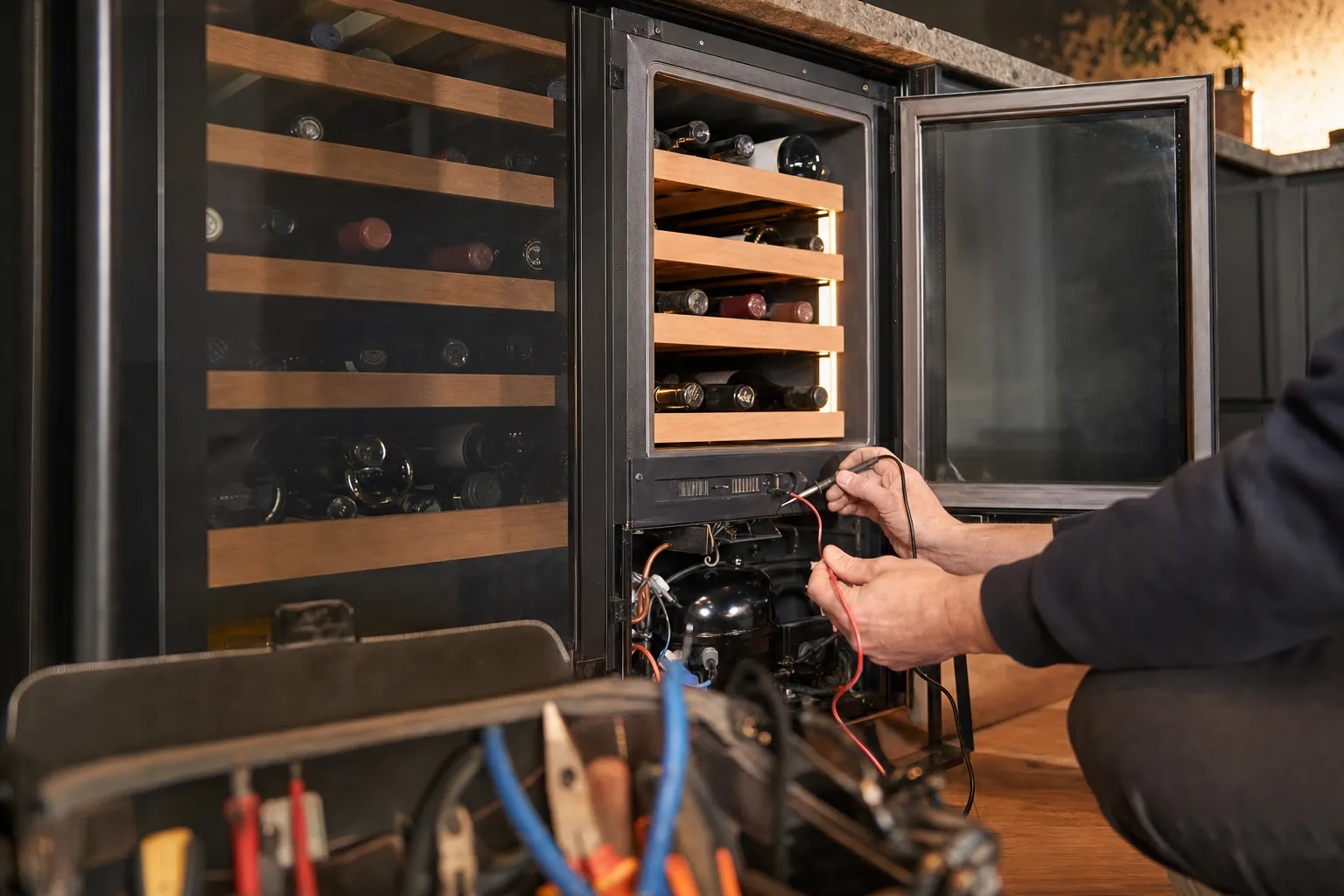
- Compressor
- Meter probes
- Wine racks
Pattern Ledger
Wine Cooler at Room Temp: how it usually goes
- Most often Condenser fan stopped, usually behind a lint-packed coil
-
Gives itself away by The cabinet seems to run without end, warm air barely leaves the base, and dust is visible at the lower grille
Price band Evaporator or condenser fan motor$330–$690
- Sometimes Control no longer switching the compressor on
-
Gives itself away by Display and lights behave normally, yet the base stays silent and cool to the touch hour after hour
Price band Electronic control board$420–$920
- Rarely Leak or restriction in the sealed system
-
Gives itself away by Compressor and fans both running, the condenser clean, and still no real cold inside after a full day
Price band Compressor or sealed-system repair$1,410–$3,350
Telling these three apart is what the $89 visit is for. Sub-Zero Appliance Repair Seattle · (206) 339-4211
One fault, both zones
Both zones depend on the same machine compartment: the condenser, the fan that draws air across it, the compressor and the control that starts it. When the whole cabinet drifts to kitchen temperature at once, the search starts there, not inside a zone.
What the machine compartment usually shows
Sub-Zero’s checklist for a warm wine unit asks for the condenser to be cleaned if that has not happened in the last three months, tighter than the six to twelve months it gives its refrigerators. A clogged coil makes the compressor run long and hot, and the fan beside it is often what finally gives up. Less often the control stops powering the compressor. A sealed-system fault comes last, confirmed with gauges before it is quoted.
What you can check safely
- Read the set point on the display. Sub-Zero's electronic wine controls accept 34°F to 65°F, and a key brushed while dusting can move it without anyone noticing.
- Clear anything stacked against the ventilation grille at the base: a case of bottles, a rug edge, a recycling bin.
- Think about the room. Sub-Zero rates its indoor units for 60°F to 90°F, so a cold garage or an overheated pantry is a cause in its own right.
Owner checks end there. Sealed tubing, wiring behind the grille and anything held by screws belongs on a service call — Sub-Zero Appliance Repair Seattle, (206) 339-4211.
Questions owners ask about this
Can I clean the condenser on my wine cabinet myself?
Yes. Sub-Zero publishes a cleaning procedure for its undercounter and wine models: brush and vacuum the dust away, do not bend the aluminum fins, and skip chemical cleaners. If the cabinet is still warm a day after a proper clean, the cause lies further in and is worth a visit.
Should I move the bottles while the cabinet is warm?
Only if a cooler spot is close at hand. Otherwise keep the door shut, leave the unit plugged in so the fault is still there when it is tested, and call Sub-Zero Appliance Repair Seattle on (206) 339-4211. The $89 service call covers the diagnosis at the base.
How do you tell a failed fan from a compressor that will not start?
By testing rather than guessing. We check whether the control is sending power to the compressor, whether the condenser fan turns under power, and what the coil and tubing feel like. A running compressor with a stopped fan and a silent compressor with a turning fan lead to very different repairs.